


The Applicability of the Chagos Advisory Opinion to other Ongoing Territorial Disputes: The Example of the Matthew and Hunter Dispute between France and Vanuatu
Introduction
The May 2025 agreement between government officials in London and Port Louis on the sovereignty of the Chagos Islands—including Diego Garcia[1]—was recently defended by the United Kingdom and Mauritian authorities after it was criticized by Donald Trump.[2] The outcome of negotiations concerning the fate of the Indian Ocean archipelago, whose population was deported after its detachment from Mauritius, is the result of a very long political struggle and an equally long judicial battle.
The 2019 advisory opinion issued by the ICJ on this matter,[3] while decisive in the still pending outcome of this dispute, reiterated principles that are essential to international law and, more specifically, to the settlement of territorial disputes arising from decolonization. As such, its content is now relevant to the settlement of many other territorial disputes.
This Insight explores the potential impact of the Chagos Opinion on the ongoing dispute between France and Vanuatu over the Matthew and Hunter Islands (Matthew and Hunter), as the two countries currently hold new formal negotiations to resolve the dispute. Both concluded their first round of negotiations in November 2025, following a Joint Communique stating that they agreed to maintain an open and constructive dialogue, aiming for an amicable resolution.[4] The second round of negotiations between the two countries is currently being prepared and is scheduled to be held sometime in 2026.[5]
The affirmation of the right to territorial integrity of a non-self-governing territory as a corollary of the right to self-determination
The right to self-determination is a cardinal principle in modern international law with a long history.[6] It was first a philosophical and political concept before being included in the UN Charter (Article 1.2) and the 1966 human rights Covenants[7] and confirmed by General Assembly resolutions, notably resolutions 1514(XV),[8] 1541(XV),[9] and 2625 (XXV).[10]
Its nature and scope has also been clarified by international case law, notably by the 1971 ICJ Advisory Opinion on Namibia[11] and, more recently, by the 2019 ICJ Advisory Opinion on the Chagos Islands.[12] In these opinions, the ICJ provided substantial elements to the application of self-determination regarding its nature and scope and to its corollary, the territorial integrity of colonized countries.
Drawing on state practice over time and Resolution 1514(XV), the ICJ observed that states “have consistently emphasized that respect for the territorial integrity of a non-self-governing territory is a key element of the exercise of the right to self-determination under international law.”[13] Also, while assessing the legal consequences of the separation of the Chagos Islands, the Court declared in 2019:
[P]eoples of non-self-governing territories are entitled to exercise their right to self-determination in relation to their territory as a whole, the integrity of which must be respected by the administering Power. It follows that any detachment by the administering Power of part of a non-self-governing territory, unless based on the freely expressed and genuine will of the people of the territory concerned, is contrary to the right to self-determination.[14]
Further, the judges confirmed “the customary law character of the right to territorial integrity of a non-self-governing territory as a corollary of the right to self-determination.”[15]
In the case of the Chagos Islands, three General Assembly resolutions on Mauritius had already pinpointed this principle before the ICJ advisory opinion: Resolutions 2066 (XX),[16] 2232 (XXI),[17] and 2357 (XXII).[18] In the Chagos advisory opinion, the judges observed that the 1965 Lancaster House Agreement was not the “free and genuine expression of the will of the people concerned,”[19] and therefore concluded, by 13 votes to one, that the UK’s separation of the Chagos Islands from the rest of Mauritius in 1965 was unlawful.
The history of the independence of Mauritius is not the only situation for which the principle of territorial integrity was applied by the UN General Assembly to colonized territories. The UNGA recognized this principle during the decolonization process of French colonies, namely Mayotte[20] and the Scattered Islands (Îles Éparses).[21] Although there is no such UN resolution dedicated to the Matthew and Hunter dispute, the principles affirmed in the Chagos opinion will be crucial to the ongoing negotiations and potential resolution of the dispute between France and Vanuatu.
The application of the Chagos opinion to the Matthew and Hunter Islands dispute
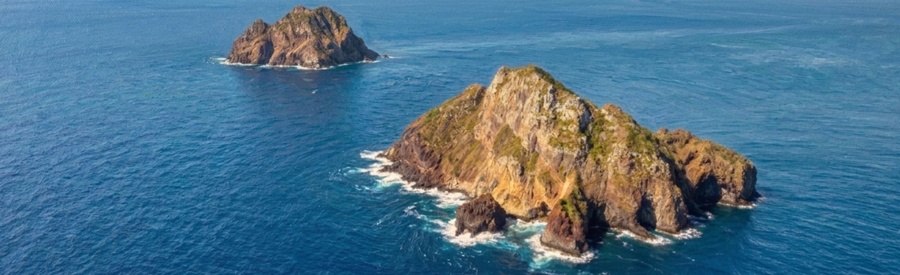
Matthew and Hunter (Umaenupne and Leka in the local languages of Anatom and Futuna in Vanuatu) are two volcanic formations that are difficult to access. Far from inhabited land, they are located approximately 280 km southeast of Vanuatu and approximately 445 km from the Grande Terre of New Caledonia (a French archipelago listed by the UN as a no-self-governing territory). They are also very small in size (approximately 0.6 and 0.7 km).2 Vanuatu has claimed sovereignty over them since its independence in 1980, highlighting in particular the historical customary value of the islets, while France also includes them in its territory.[22] The government of New Caledonia has also incorporated them into the boundaries of the Coral Sea Park, one of the largest marine protected areas in the world.
Matthew and Hunter only acquired geostrategic significance with the evolution of the law of the sea, and today cover about one-fifth of New Caledonia's EEZ (with a total area of 1.2 million km2). The existence of the dispute prevents the conventional demarcation of the maritime boundary of the EEZ between France and Vanuatu, a blockage that is all the more significant in light of the current tensions in the Indo-Pacific region. It has also had the knock-on effect of suspending consideration of the request to extend the continental shelf beyond 200 nautical miles east of New Caledonia by the Commission on the Limits of the Continental Shelf, which is responsible for making the appropriate recommendations. Also, according to a strict interpretation of the United Nations Convention on the Law of the Sea and its Article 121, the definition of Matthew and Hunter (are they rocks or islands?) could be called into question. Nevertheless, neither France nor Vanuatu base their claim on Article 121.
The answer to the question of which state has sovereignty over Matthew and Hunter seems difficult to establish for several reasons, not least because no one really questioned it before the 1960s. In 1962, two atypical characters, aviation pioneers Bob Paul and Henri Martinet, probably as the result of a simple bet, sought to claim Matthew for themselves. But, before its independence, the “New Hebrides” archipelago was a Franco-British condominium—that is to say a territory under the administration of two states—established by convention in 1906. So when, in 1962, the joint court of Port Vila was asked to register Matthew by Mrs. Paul and Martinet, the first question was that of the court's jurisdiction and therefore whether or not the islet belonged to the New Hebrides. The court then turned to the resident commissioners of France and Great Britain, who themselves consulted their administrations about both Matthew and Hunter, without finding anything conclusive. It emerges from exchanges between Paris and London[23] that the two powers had agreed that Matthew and Hunter should be attached to New Caledonia, a decision that boded well for France and meant that the court did not have to rule on the ownership application. They did so, though, without consulting the local populations.[24]
For that reason, one of the pending questions today is to know whether or not the 1965 Franco-British agreement violated the principle of territorial integrity of the former condominium (which applies to the entire territories, even the inhabited parts). Of course, the parallel between the dispute over the Matthew and Hunter Islands and the Chagos archipelago’s detachment from Mauritius has some important limits (notably because no population was forcibly transferred from the Matthew and Hunter islands) but the same principle of territorial integrity plays a key role.
Self-determination is not the only legal principle to be taken into account here. If the dispute were to be resolved in court, which seems highly unlikely, the judges would probably also look, in the absence of a treaty, at the actual manifestations of sovereignty prior to the dispute, as well as the rights of indigenous fishermen.
Conclusion
Although the final settlement of the Chagos dispute has been hampered by the recent twists and turns of the Trump administration, the signing of an agreement between London and Port Louis following the ICJ's advisory opinion has shown that advisory proceedings are sometimes surprisingly more effective than lengthy litigation.
Even if the Matthew and Hunter dispute is unlikely to go to a court, the parties will undoubtedly negotiate under the shadow of the law as it was interpreted by the ICJ in 2019. Clarification of the law has pacifying virtues that should not be overlooked despite the current challenges faced by the international order. It is therefore hoped that the interpretations of territorial integrity and self-determination adopted by of the UN court on the Chagos will help to resolve other territorial disputes related to decolonization, such as the one concerning Matthew and Hunter.
About the Authors:
Géraldine Giraudeau is a full Professor in law at the University of Paris-Saclay (UVSQ) and a junior member of the Institut universitaire de France. She was recently a visiting scholar at Te Herenga Waka- University of Wellington.
Dr. Morsen Mosses is a Senior Lecturer in Law at the University of the South Pacific. He teaches and conducts research in public international law, human rights law and legal pluralism in the Pacific.
Dr. Lili Song is a senior lecturer in law at the University of Otago, New Zealand. She previously taught at the University of the South Pacific in Vanuatu and was recently a visiting scholar at Harvard University.
[1] Agreement Concerning the Chagos Archipelago, Including Diego Garcia, U.K.-Mauritius, May 22, 2025, CS Mauritius No. 1 (2025), https://www.gov.uk/government/publications/ukmauritius-agreement-concerning-the-chagos-archipelago-including-diego-garcia-cs-mauritius-no12025.
[2] Trump Criticises Chagos Islands Deal After Starmer Defends Agreement, Guardian (Feb. 5, 2026), https://www.theguardian.com/world/2026/feb/05/trump-criticism-chagos-islands-starmer.
[3] Legal Consequences of the Separation of the Chagos Archipelago from Mauritius in 1965, Advisory Opinion, 2019 I.C.J. Rep. 95 (Feb. 25).
[4] Gouvernement de la République française & Gov’t of Vanuatu, Joint Communiqué from Vanuatu and France on Their Commitment to Maritime Delimitation (July 23, 2025), https://www.elysee.fr/en/emmanuel-macron/2025/07/23/joint-communique-from-vanuatu-and-france-on-their-commitment-to-maritime-delimitation.
[5] Press Release, Prime Minister’s Off., Gov’t of Vanuatu, https://pmo.gov.vu/en/public-information/press-release.html.
[6] Self-determination is the subject of abundant academic literature. For recent publications on the history of self-determination, see, e.g., Philippe Sands, Colonialism: A Short History of International Law in Five Acts, 431 Recueil des Cours 298 (2023); Tobias Sparks, Self-Determination in the International Legal System (2023).
[7] International Covenant on Civil and Political Rights, Dec. 16, 1966, 999 U.N.T.S. 171; International Covenant on Economic, Social and Cultural Rights, Dec. 16, 1966, 993 U.N.T.S. 3.
[8] G.A. Res. 1514 (XV), Declaration on the Granting of Independence to Colonial Countries and Peoples (Dec. 14, 1960).
[9] G.A. Res. 1541 (XV) (Dec. 15, 1960).
[10] G.A. Res. 2625 (XXV), Declaration on Principles of International Law Concerning Friendly Relations and Co-operation Among States in Accordance with the Charter of the United Nations (Oct. 24, 1970).
[11] Legal Consequences for States of the Continued Presence of South Africa in Namibia (South West Africa) Notwithstanding Security Council Resolution 276 (1970), Advisory Opinion, 1971 I.C.J. Rep. 16 (June 21).
[12] Legal Consequences of the Separation of the Chagos Archipelago from Mauritius in 1965, Advisory Opinion, 2019 I.C.J. Rep. 95 (Feb. 25) [hereinafter Chagos Advisory Opinion].
[13] Chagos Advisory Opinion, supra note 12, ¶ 160.
[14] Id. ¶ 161.
[15] Id. ¶ 163.
[16] G.A. Res. 2066 (XX), Question of Mauritius (Dec. 16, 1965).
[17] G.A. Res. 2232 (XXI), Question of American Samoa, Antigua, Bahamas, Bermuda [et al.] (Dec. 20, 1966).
[18] G.A. Res. 2357 (XXII), Question of American Samoa, Antigua, Bahamas, Bermuda [et al.] (Dec. 19, 1967).
[19] Id. ¶ 172.
[20] The U.N. General Assembly, at the request of Comorian authorities, has consistently recognized Comorian sovereignty over Mayotte and condemned its attachment to France under the principles of self-determination and territorial integrity. See G.A. Res. 3161 (XXVIII) (Dec. 14, 1973); G.A. Res. 3291 (XXIX) (Dec. 13, 1974); G.A. Res. 31/4 (Oct. 21, 1976); G.A. Res. 49/18 (Dec. 6, 1994).
[21] G.A. Res. 34/91, Question of the Islands of Glorieuses, Juan de Nova, Europa and Bassas da India (Dec. 12, 1979) (reaffirming “the necessity of scrupulously respecting the national unity and territorial integrity of a colonial territory at the time of its accession to independence”).
[22] In Vanuatu, Matthew and Hunter are part of ancestral beliefs. See Lili Song, Morsen Mosses & Géraldine Giraudeau, The Ambiguous History of Matthew and Hunter Islands: Tracing the Roots of Vanuatu and French Claims, 58 J. Pac. Hist. 232, 232 (2023). For a French official source, see Loi organique n°99-209 du 19 mars 1999 relative à la Nouvelle-Calédonie.
[23] Song, Mosses & Giraudeau, id., at 240 (based on archival research conducted by the authors).
[24] Affirmation based on archival research. See Song, Mosses & Giraudeau, supra note 22.