


Advancing Gender Justice
The ASIL Signature Topic on Advancing Gender Justice aims to spark and advance conversations, dialogue and engagement with what it means to achieve gender justice in international law and institutions. The signature topic aims to explore the meaning of “gender justice” almost 30 years after the 1995 Fourth World Conference on Women in Beijing; while significant strides have been made in the past three decades, much remains to be done to achieve international law’s potential.
In line with ASIL’s role as a top convenor in the field of international law, the initiative will host events and gatherings on cutting-edge issues involving gender justice in an effort to illuminate areas of convergence and divergence in movements and efforts to achieve the rights of women, in all their diversity, and gender justice more broadly, to highlight recent successes and failures of international law and institutions, and to discuss obstacles to and strategies for achieving gender justice, both within the ASIL community and beyond, while recognizing and questioning the limits of international law and institutions.
Originally streamed: 12/12/2025
Description: In October 2025, the International Court of Justice issued an advisory opinion addressing the legal framework governing international organizations operating in and in relation to the Occupied Palestinian Territory. The Court found that an occupying Power must respect UN privileges and immunities even in occupied territory, limiting unilateral measures affecting UN entities, personnel, premises, and assets. At the same time, the Judges sharply diverged on the scope of Article 2(5) of the Charter, specifically whether Member States must provide “every assistance” to the United Nations even when they contest its legality or mandate.
In this online discussion, Professor Mohamed Helal—the Arab League's counsel in the proceedings—will discuss how these two strands of the opinion interact, what they require of the occupying Power, and how they affect operational space for the United Nations. He will examine the practical implications for access, security, and institutional independence, as well as the broader consequences for the UN’s ability to carry out its mandates in complex conflict environments.
Panelists:
Originally streamed: 10/29/2025
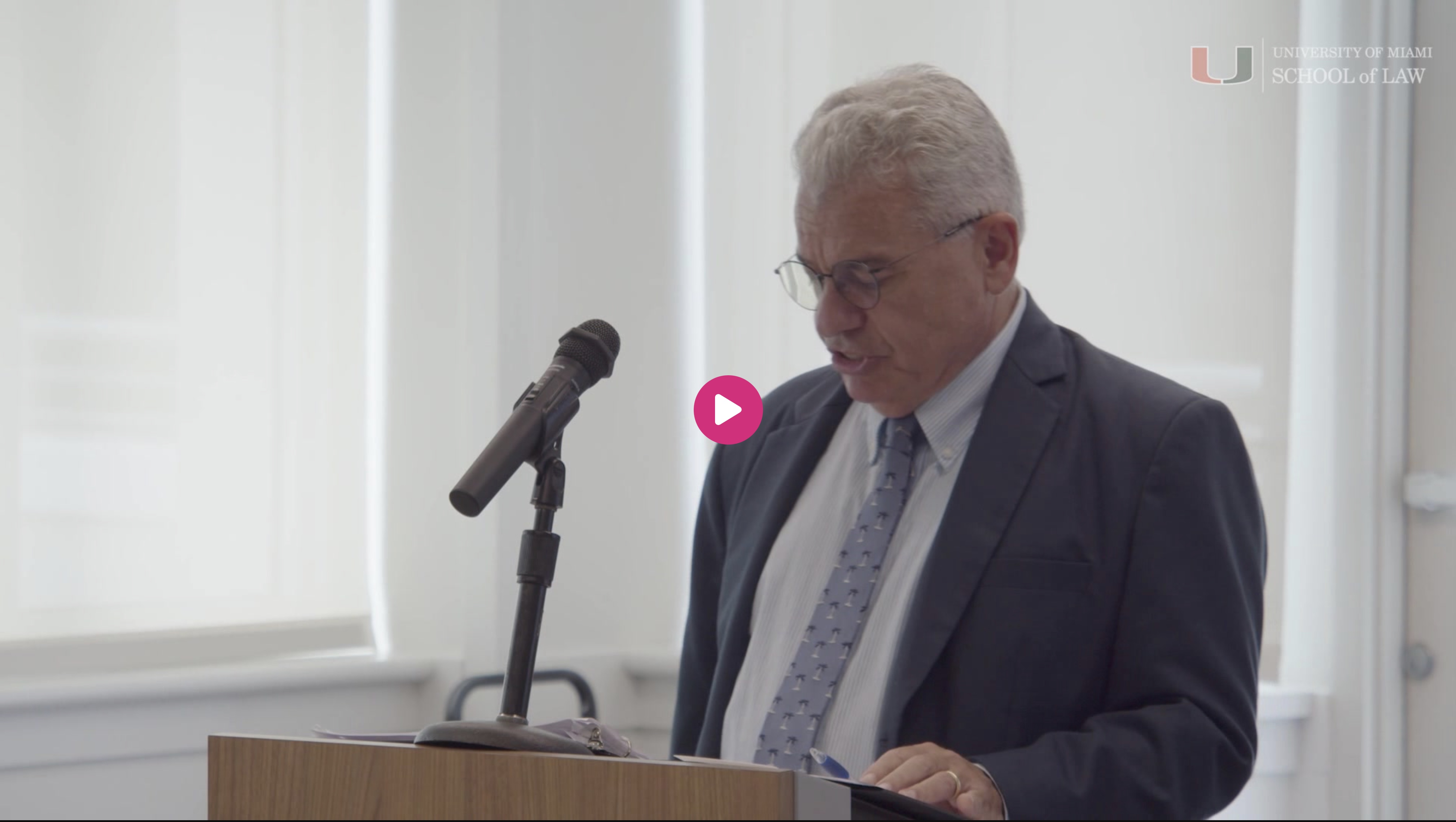
Description: Professor Jose Enrique Alvarez shared his pearls of wisdom at Miami Law on Oct. 29. Professor Alvarez's excellent lunchtime talk on "Women’s Economic Empowerment at the UN" was featured as part of Miami Law's Legal Theory Workshop and was co-billed as an event for the American Society of International Law's Signature Topic, Advancing Gender Justice in International Law. The video for the talk can be found here: https://lnkd.in/eW5Cngft. The flyer for the talk can be found here: https://lnkd.in/euikRFuy. Thank you, Professor Alvarez, for your engagement with our students and faculty, and your deeply insightful presentations!
Originally streamed: 12/10/2025
Description: In a moment marked by both unprecedented progress and powerful backlash, LGBTQ+ rights are once again at the center of legal and political debate—at home and abroad. From groundbreaking recognition in international law to the resurgence of anti-LGBTQI+ policies in the United States and around the world, the global landscape is shifting rapidly.
This panel will explore where we are now in the global struggle for LGBTQI+ rights, what progress has been made through legal mechanisms, and how that progress is being challenged. A key milestone came in July 2025, when the International Criminal Court (ICC) issued arrest warrants against senior Taliban leaders, recognizing, for the first time in international tribunal history, crimes against humanity of gender persecution that include LGBTQI+ victims. At the same time, recent policy shifts in the U.S. are contributing to a broader global rollback. These changes have emboldened anti-LGBTQI+ movements worldwide, with chilling effects for activists, advocates, and the rule of law.
Join us for a timely discussion on International Human Rights Day with leading experts in international human rights, U.S. policy, and legal advocacy to unpack what this moment means for the future of LGBTQI+ rights and how legal practitioners can respond.
Panelists:
Originally streamed: 5/20/2025
Description: This webinar, which is part of ASIL’s Signature Topic on Advancing Gender Justice, aims to take stock of several initiatives to increase the participation of women, in all their diversity, in various spaces of international law and from different perspectives. These will include, among others, UN and regional human rights institutions, the International Court of Justice, the Women, Peace and Security framework, and perspectives from Africa and Latin America. In a roundtable format, speakers will address where we are today, what has already been done, what remains outstanding, and challenges to advancing the equal participation of women, in all their diversity, as a component of achieving gender justice. The event is co-sponsored by the Gqual Campaign, the Institute for African Women in Law, and by the Working Group on Gender Parity for the International Court of Justice.
Panelists:
Originally streamed: 12/10/2024
Description: This webinar will gather experts on gender justice and international law to take stock of how the Biden-Harris administration has approached gender justice from both international and domestic law perspectives. What were areas of synergy with, or divergence from, past domestic and foreign law and policy priorities of the U.S.? What did the Biden-Harris administration accomplish? What was left on the table? Panelists will examine these questions and outline possibilities and concerns for the next administration.
This panel marks the inaugural virtual event of ASIL’s new Advancing Gender Justice Signature Topic, which aims to spark and advance conversations, dialogue and engagement with what it means to achieve gender justice in international law and institutions. Among the signature topic’s goals are to identify areas of convergence and divergence in movements and efforts to achieve the rights of women, in all their diversity, and gender justice more broadly, to highlight recent successes and failures of international law and institutions, and to discuss obstacles to and strategies for achieving gender justice, both within the ASIL community and beyond, while recognizing and questioning the limits of international law and institutions.
Panelists:
Originally streamed: 07/24/2024
Description: As governments grapple with numerous complex challenges, more traditional approaches to foreign and security policy need rethinking. So do underlying assumptions about gender, power, and security.
Feminist foreign policy (FFP) has emerged as a new paradigm, building on legal frameworks, feminist international relations theory, women’s movements, and the women, peace, and security agenda. FFP is a bold commitment, signaling to those inside government, civil society and other states that gender equality is a foreign policy goal and fundamental to peace, security and stability.
This panel will address how FFP differs from traditional foreign policy, or one focused on advancing the rights of women and girls. The panelists will discuss the theory and practice of FFP, with examples from two counties that are implementing an FFP (one from Latin American and one from Europe) and highlight the perspective of civil society advocates for FFP.
FFP differs across countries but encompasses key principles. It is a framework to integrate gender equality across diplomacy, foreign assistance, defense and security cooperation, and trade. It widens the definition of security and addresses historic power imbalances. It values more diverse voices in policymaking, from both inside and outside government.
Panelists:
In line with ASIL’s role as a top convenor in the field of international law, the initiative will host events and gatherings on cutting-edge issues involving gender justice in an effort to illuminate areas of convergence and divergence in movements and efforts to achieve the rights of women, in all their diversity, and gender justice more broadly, to highlight recent successes and failures of international law and institutions, and to discuss obstacles to and strategies for achieving gender justice, both within the ASIL community and beyond, while recognizing and questioning the limits of international law and institutions.
Signature Topic Co-Chairs:
Steering Committee:
Advisors to the Steering Committee:
Aides to the Steering Committee:
- Christina Beharry (Foley Hoag)
- Carrie Bettinger-Lopez (University of Miami)
- Nienke Grossman (University of Baltimore)
Steering Committee:
- Jose Alvarez, NYU
- Karima Bennoune, University of Michigan
- Lisa Davis, CUNY
- J. Jarpa Dawuni, Howard University
- Patricia Galvao Teles, ILC/Autonomous University of Lisbon
- Maria Leoni, GQUAL
- Valerie Oosterveld, Western University
- Catherine Powell, Fordham School of Law
- Akila Radhakrishnan, Atlantic Council
- Philippa Scarlett, RELX
- Payal Shah, Physicians for Human Rights
- Adrien Wing, University of Iowa
Advisors to the Steering Committee:
- Catherine Amirfar, Debevoise & Plimpton
- Bernie Oxman, University of Miami
Aides to the Steering Committee:
- Eva Treves, Foley Hoag
- Iulia Padeanu Mellon, Foley Hoag
- Maria Camila Rincon, Foley Hoag
EVENTS
Originally streamed: 12/12/2025
Description: In October 2025, the International Court of Justice issued an advisory opinion addressing the legal framework governing international organizations operating in and in relation to the Occupied Palestinian Territory. The Court found that an occupying Power must respect UN privileges and immunities even in occupied territory, limiting unilateral measures affecting UN entities, personnel, premises, and assets. At the same time, the Judges sharply diverged on the scope of Article 2(5) of the Charter, specifically whether Member States must provide “every assistance” to the United Nations even when they contest its legality or mandate.
In this online discussion, Professor Mohamed Helal—the Arab League's counsel in the proceedings—will discuss how these two strands of the opinion interact, what they require of the occupying Power, and how they affect operational space for the United Nations. He will examine the practical implications for access, security, and institutional independence, as well as the broader consequences for the UN’s ability to carry out its mandates in complex conflict environments.
Panelists:
- Valerie Oosterveld, University of Western Ontario Faculty of Law/Christina L. Beharry, Foley Hoag LLP (moderators and opening remarks)
- Cecilia M. Bailliet, United Nations Independent Expert on human rights and international solidarity, and Institute of Public & International Law, University of Oslo
- Lisa Davis, Professor of Law, CUNY School of Law; Co-Director, Human Rights and Gender Justice Clinic
- Susana SáCouto, Director, War Crimes Research Office, Washington College of Law, American University
- Payal Shah, Director of Research, Legal, and Advocacy, Physicians for Human Rights
Originally streamed: 10/29/2025
Description: Professor Jose Enrique Alvarez shared his pearls of wisdom at Miami Law on Oct. 29. Professor Alvarez's excellent lunchtime talk on "Women’s Economic Empowerment at the UN" was featured as part of Miami Law's Legal Theory Workshop and was co-billed as an event for the American Society of International Law's Signature Topic, Advancing Gender Justice in International Law. The video for the talk can be found here: https://lnkd.in/eW5Cngft. The flyer for the talk can be found here: https://lnkd.in/euikRFuy. Thank you, Professor Alvarez, for your engagement with our students and faculty, and your deeply insightful presentations!
Originally streamed: 12/10/2025
Description: In a moment marked by both unprecedented progress and powerful backlash, LGBTQ+ rights are once again at the center of legal and political debate—at home and abroad. From groundbreaking recognition in international law to the resurgence of anti-LGBTQI+ policies in the United States and around the world, the global landscape is shifting rapidly.
This panel will explore where we are now in the global struggle for LGBTQI+ rights, what progress has been made through legal mechanisms, and how that progress is being challenged. A key milestone came in July 2025, when the International Criminal Court (ICC) issued arrest warrants against senior Taliban leaders, recognizing, for the first time in international tribunal history, crimes against humanity of gender persecution that include LGBTQI+ victims. At the same time, recent policy shifts in the U.S. are contributing to a broader global rollback. These changes have emboldened anti-LGBTQI+ movements worldwide, with chilling effects for activists, advocates, and the rule of law.
Join us for a timely discussion on International Human Rights Day with leading experts in international human rights, U.S. policy, and legal advocacy to unpack what this moment means for the future of LGBTQI+ rights and how legal practitioners can respond.
Panelists:
- Carrie Bettinger Lopez / Nienke Grossman (moderators)
- Jessica Stern, Former U.S. Special Envoy to Advance the Human Rights of LGBTQI+ Persons (Biden Administration)
- Lisa Davis, Professor of Law, CUNY School of Law; Co-Director, Human Rights and Gender Justice Clinic
- Victor Madrigal-Borloz, former UN Independent Expert on protection against violence and discrimination based on sexual orientation and gender identity
Originally streamed: 5/20/2025
Description: This webinar, which is part of ASIL’s Signature Topic on Advancing Gender Justice, aims to take stock of several initiatives to increase the participation of women, in all their diversity, in various spaces of international law and from different perspectives. These will include, among others, UN and regional human rights institutions, the International Court of Justice, the Women, Peace and Security framework, and perspectives from Africa and Latin America. In a roundtable format, speakers will address where we are today, what has already been done, what remains outstanding, and challenges to advancing the equal participation of women, in all their diversity, as a component of achieving gender justice. The event is co-sponsored by the Gqual Campaign, the Institute for African Women in Law, and by the Working Group on Gender Parity for the International Court of Justice.
Panelists:
- Jessica Lynn Corsi, Senior Law Lecturer (Associate Professor), City St. George’s, University of London, Co-Chair, Working Group on Gender Parity for the ICJ
- J. Jarpa Dawuni, Associate Professor of Political Science, Howard, Executive Director, Institute for African Women in Law
- Anne Marie Goetz, Clinical Professor, Center for Global Affairs, NYU
- Maria Leoni, Director, Gqual Campaign, Deputy Director, CEJIL
- Nienke Grossman (moderator), Professor, University of Baltimore School of Law
Originally streamed: 12/10/2024
Description: This webinar will gather experts on gender justice and international law to take stock of how the Biden-Harris administration has approached gender justice from both international and domestic law perspectives. What were areas of synergy with, or divergence from, past domestic and foreign law and policy priorities of the U.S.? What did the Biden-Harris administration accomplish? What was left on the table? Panelists will examine these questions and outline possibilities and concerns for the next administration.
This panel marks the inaugural virtual event of ASIL’s new Advancing Gender Justice Signature Topic, which aims to spark and advance conversations, dialogue and engagement with what it means to achieve gender justice in international law and institutions. Among the signature topic’s goals are to identify areas of convergence and divergence in movements and efforts to achieve the rights of women, in all their diversity, and gender justice more broadly, to highlight recent successes and failures of international law and institutions, and to discuss obstacles to and strategies for achieving gender justice, both within the ASIL community and beyond, while recognizing and questioning the limits of international law and institutions.
Panelists:
- Caroline Bettinger-Lopez, Professor of Law, Univ. of Miami School of Law; Co-Chair, Advancing Gender Justice Signature Topic; former Senior Advisor, U.S. Department of Justice and White House Gender Policy Council: Moderator
- Suzanne Goldberg, Senior Advisor to the Under Secretary for Civil Security, Democracy, and Human Rights, U.S. Department of State; Herbert and Doris Wechsler Clinical Professor of Law, Columbia Law School (on leave)
- Catherine Powell, Eunice Carter Distinguished Research Scholar Professor of Law, Fordham Law School; former Senior Advisor on Gender-Based Violence, White House Gender Policy Council
- Akila Radhakrishnan, Strategic Legal Advisor, Gender Justice, Atlantic Council
Originally streamed: 07/24/2024
Description: As governments grapple with numerous complex challenges, more traditional approaches to foreign and security policy need rethinking. So do underlying assumptions about gender, power, and security.
Feminist foreign policy (FFP) has emerged as a new paradigm, building on legal frameworks, feminist international relations theory, women’s movements, and the women, peace, and security agenda. FFP is a bold commitment, signaling to those inside government, civil society and other states that gender equality is a foreign policy goal and fundamental to peace, security and stability.
This panel will address how FFP differs from traditional foreign policy, or one focused on advancing the rights of women and girls. The panelists will discuss the theory and practice of FFP, with examples from two counties that are implementing an FFP (one from Latin American and one from Europe) and highlight the perspective of civil society advocates for FFP.
FFP differs across countries but encompasses key principles. It is a framework to integrate gender equality across diplomacy, foreign assistance, defense and security cooperation, and trade. It widens the definition of security and addresses historic power imbalances. It values more diverse voices in policymaking, from both inside and outside government.
Panelists:
- Caroline Bettinger-Lopez (moderator), University of Miami School of Law
- Stephenie Foster (co-author), Smash Strategies
- Elisabeth Franz, German Embassy, Washington, DC
- Susan Markham (co-author), Smash Strategies
- Gayatri Patel, Coalition for a Feminist Foreign Policy in the U.S.
- Arlene Tickner, Deputy Permanent Representative of Colombia to the United Nations