


The Security Council as Architect? Resolution 2803, the Board of Peace, and the Limits of Transition in Gaza
Introduction
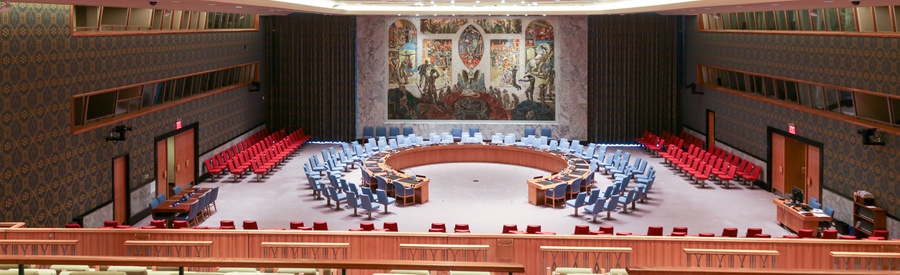
On November 17, 2025, the United Nations Security Council adopted Resolution 2803, endorsing what U.S. President Donald Trump has termed his “Comprehensive Plan to End the Gaza Conflict.” Adopted by a vote of 13-0-2, with Russia and China abstaining, the resolution authorizes two novel institutional mechanisms: a Board of Peace (BoP) to serve as a transitional governance administration chaired by President Trump, and a temporary International Stabilization Force (ISF) tasked with demilitarizing Gaza and providing security.[1]
The resolution arrives sixteen months after the International Court of Justice’s (ICJ) sweeping Advisory Opinion declaring Israel’s continued presence in the Occupied Palestinian Territory (OPT) unlawful and affirming the Palestinian people’s inalienable right to self-determination.[2] While the resolution’s proponents argue it offers a pragmatic exit from the devastating conflict, its adoption raises foundational questions about the Security Council’s authority to re-engineer governance arrangements in occupied territory without the consent of the people concerned.
This Insight examines Resolution 2803’s legal architecture, situates it within the precedents of UN territorial administration and the ICJ Advisory Opinion, and identifies the tensions between a Council-driven “transition” and the imperatives of the law of occupation.
The Resolution’s Legal Architecture
Resolution 2803 establishes a two-pillar framework for post-conflict Gaza. The first pillar is the Board of Peace. Described as “a transitional administration with international legal personality,” the BoP is empowered to “set the framework, and coordinate funding, for the redevelopment of Gaza” until the Palestinian Authority (PA) “has satisfactorily completed its reform program.”[3] Notably, the Board is not a UN subsidiary body; it is a sui generis entity chaired by the head of state of a permanent Council member—an arrangement without precedent in UN practice.
Although Annex I indicates President Trump will chair the BoP with former UK Prime Minister Tony Blair the sole named member among an otherwise unspecified group of heads of state, the resolution establishes no criteria for Board appointments, no guarantee of Palestinian representation, and no mechanism for UN oversight of the entity charged with supervising Gaza's technocratic administration.[4] The lack of specified selection criteria has drawn criticism from several Council members: China’s representative noted the resolution was “vague and unclear” on the Board’s “structure, composition and terms of reference,”[5] while Slovenia called for “clear terms of reference” stressing the need for “inclusivity, transparency and good faith.”[6]
The second pillar is the International Stabilization Force (ISF). Authorized under Chapter VII to “use all necessary measures,” the ISF is tasked with demilitarizing Gaza, decommissioning weapons from non-state armed groups, and coordinating with Israel and Egypt on border security.[7] The resolution mandates the ISF to “protect civilians, including humanitarian operations,” and both the BoP and ISF are tasked with coordinating humanitarian assistance “in cooperation with . . . the United Nations” and ensuring aid is not diverted by armed groups.[8] However, a critical omission weakens these provisions: while the annexed Comprehensive Plan calls for immediate and full aid deliveries without interference,[9] the resolution text itself imposes no specific obligation on Israel to facilitate or cease obstructing humanitarian access. The responsibility for enabling aid delivery rests with the BoP rather than with Israel as the occupying power, an arrangement humanitarian agencies have flagged as creating operational uncertainty.[10]
Russia circulated a competing draft resolution that would have placed the stabilization force within established UN peacekeeping architectures, subject to a Status of Forces Agreement with the host entity. By abstaining rather than vetoing, Moscow and Beijing allowed the resolution to pass while distancing themselves from its implementation.[11]
Critically, the resolution’s approach to Palestinian statehood is strictly conditional: only “[a]fter the PA reform program is faithfully carried out and Gaza redevelopment has advanced” may “the conditions . . . finally be in place for a credible pathway to Palestinian self-determination and statehood.”[12] The resolution makes no explicit reference to the two-state solution or the July 2024 ICJ Advisory Opinion—omissions several Council members, including Algeria, France, Pakistan, Guyana, and Sierra Leone, criticized as legally significant.[13]
International Territorial Administration: A New Species of Trusteeship?
Resolution 2803 invites comparison with the Security Council’s most ambitious experiments in International Territorial Administration: UNMIK in Kosovo (Resolution 1244) and UNTAET in East Timor (Resolution 1272). Both vested comprehensive governmental authority in UN-led administrations, representing what scholars have termed “fourth-generation peacekeeping.”[14]
The Gaza framework differs in critical respects. First, UNTAET operated following an internationally supervised referendum in which the East Timorese voted overwhelmingly for independence, providing a clear expression of self-determination.[15] Resolution 2803 imposes an administration without Palestinian consent. The BoP is not an interim steward preparing a territory for inevitable independence; rather, it is a gatekeeper empowered to determine if and when the population is ready for sovereignty.
Second, UNMIK and UNTAET were subsidiary organs answerable to the Secretary-General and Security Council. The BoP operates with an autonomy that challenges the principle that the Security Council cannot delegate its Charter-mandated authority to non-UN entities—the delegation of powers doctrine—without maintaining appropriate oversight and accountability. Entrusting governance to a hybrid entity dominated by a single member state raises concerns about bypassing the Charter’s trusteeship system (Chapter XII), which fell into disuse precisely because of its colonial connotations.[16] Russia’s representative warned that the arrangement is “reminiscent of colonial practices.”[17] The concern carries historical weight. The creation of a distinct administrative regime for Gaza, severed from the West Bank and East Jerusalem, echoes a longer pattern of external powers partitioning the region from the Mandate system to the 1947 Partition Plan, arrangements that continue to shape the conflict.[18]
The ICJ Advisory Opinion and the “Illegality” Dilemma
The July 2024 ICJ Advisory Opinion found that Israel’s “continued presence in the Occupied Palestinian Territory is unlawful” and that Israel is “under an obligation to bring to an end its unlawful presence . . . as rapidly as possible.”[19] By authorizing the ISF to coordinate with Israel on border security and permitting Israel to maintain a “security perimeter,” Resolution 2803 implicitly validates the continued presence of Israeli forces that the ICJ declared illegal.
The Court held that the right to self-determination “cannot be made conditional upon bilateral negotiations with the occupying Power.”[20] Resolution 2803 introduces a new layer of conditionality. By making statehood contingent on reform benchmarks defined by the BoP, the resolution transforms an inalienable right into a conditional privilege. As Sierra Leone’s representative noted, the Council cannot “extinguish, suspend or condition” a right that “exists independently of any peace plan.”[21] Notably, Sierra Leone and several other critics nevertheless voted for the resolution, prioritizing the fragile ceasefire over their legal objections.[22]
The Advisory Opinion also found that states are “under an obligation not to recognize as legal the situation arising from Israel’s unlawful presence.”[23] Whether the BoP framework, which relies on Israeli security perimeters, forces member states to violate this non-recognition obligation remains an open question. Moreover, the Court emphasized that the Occupied Palestinian Territory constitutes “a single territorial unit” comprising the West Bank, East Jerusalem, and Gaza.[24] By establishing a governance framework applicable only to Gaza with no mechanism for reunification under Palestinian authority, Resolution 2803 risks entrenching the very territorial fragmentation the Advisory Opinion implicitly condemned.
Moreover, the resolution creates ambiguity around occupation law responsibilities. Under the Fourth Geneva Convention, Gaza remains occupied territory wherein the occupying power bears ultimate responsibility for the welfare and public order of the protected population.[25] Resolution 2803, however, fragments this accountability: Israel could claim relief from its occupation duties while the BoP—lacking a treaty basis with a sovereign Palestinian state—operates with immunity. Resolution 2803 envisions Israeli withdrawal “based on standards, milestones, and timeframes linked to demilitarization,” but permits “a security perimeter presence . . . until Gaza is properly secure.”[26] The ICJ found that Israel’s obligations “remained commensurate with the degree of its effective control” even after the 2005 disengagement.[27] The resolution thus creates a parallel governance framework that leaves Palestinians in legal limbo.
Self-Determination and the Limits of Council Authority
While the Council possesses broad Chapter VII powers, the prevailing view is that it cannot contravene jus cogens norms or defeat the UN’s purposes.[28] The right to self-determination is widely recognized as peremptory. Francesca Albanese, Special Rapporteur on the situation of human rights in the Palestinian territories occupied since 1967, characterized the resolution as “replac[ing] clear legal obligations towards Palestinians with a security-first, capital-driven model of foreign control.”[29]
If the Council mandates a “transition” that effectively prevents the exercise of self-determination for an indefinite period, the question becomes: is the resolution ultra vires? By placing the BoP as arbiter of Palestinian readiness for statehood, the Council may have crossed from dispute settlement to the abrogation of inherent rights.
Conclusion
Resolution 2803 reflects a tension between the pragmatic imperatives of conflict resolution and the principled requirements of self-determination and occupation law. Its supporters point to the fragility of the ceasefire and urgent humanitarian needs. Its critics argue that a “peace” imposed without meaningful Palestinian ownership cannot satisfy the right to self-determination. As the Board of Peace begins its tenure, legal observers will watch two indicators: whether the BoP’s decrees respect the conservationist principle of occupation law, and whether the ISF operates as a neutral peacekeeper or as proxy for Israel’s security perimeter.
About the Author: Safia Southey is an independent researcher and consultant specializing in post-conflict justice and international human rights law, currently completing her final year at Columbia Law School and an LL.M. in International Criminal Law at the University of Amsterdam. Her work focuses on accountability, reparations, sanctions policy, and the design and evaluation of transitional justice mechanisms, with a regional focus on the Middle East and conflict-affected communities.
[1] S.C. Res. 2803 (Nov. 17, 2025). The vote was 13-0-2, with Russia and China abstaining. See U.N. Press Release SC/16225 (Nov. 17, 2025).
[2] Legal Consequences Arising from the Policies and Practices of Israel in the Occupied Palestinian Territory, Including East Jerusalem, Advisory Opinion, 2024 I.C.J. (July 19) [hereinafter ICJ Advisory Opinion].
[3] S.C. Res. 2803, ¶ 2.
[4] S.C. Res. 2803, Annex 1, ¶ 9.
[5] UNIFEED, UN / Gaza Stabilization Force Vote (Nov. 17 2025), https://media.un.org/unifeed/en/asset/d350/d3502510.
[6] United Nations Meetings Coverage, Security Council Authorizes International Stabilization Force in Gaza, Adopting Resolution 2803 (2025) (Nov. 17, 2025), https://press.un.org/en/2025/sc16225.doc.htm.
[7] S.C. Res. 2803, ¶ 7.
[8] Id.
[9] Id., Annex 1, ¶¶ 7–8.
[10] Marc Weller, What is Security Council Resolution 2803, and What `Does it Mean for the Trump Gaza Plan? Chatham House (Nov. 21, 2025), https://www.chathamhouse.org/2025/11/what-security-council-resolution-2803-and-what-does-it-mean-trump-gaza-plan.
[11] For Russia’s explanation of its abstention, see U.N. SCOR, 80th Sess., 10046th mtg., U.N. Doc. S/PV.10046, at 14 (Nov. 17, 2025) (statement of Russia). Russia had circulated an alternative draft. See Security Council Report, What’s In Blue (Nov. 16, 2025).
[12] S.C. Res. 2803, ¶ 2.
[13] Zaha Hassan, By Endorsing the U.S. Gaza Plan, the UN Security Council Elevates “Rule by Law” Over Rule of Law, Carnegie Endowment (Dec. 5, 2025), https://carnegieendowment.org/research/2025/12/un-security-council-endorse-us-gaza-plan-international-law?lang=en.
[14] Richard Caplan, International Governance of War-Torn Territories (2005); Simon Chesterman, You, The People (2004); Carsten Stahn, The United Nations Transitional Administrations in Kosovo and East Timor, 5 Max Planck Y.B. U.N. L. 105 (2001).
[15] Ralph Wilde, International Territorial Administration 188 (2008).
[16] See U.N. Charter arts. 75-85. The last trust territory (Palau) achieved independence in 1994.
[17] U.N. Doc. S/PV.10046, supra note 11, at 14 (statement of Russia).
[18] See W. Khalidi, The Palestine Problem: An Overview, 21 J. Palestine Stud. 5 (1991).
[19] ICJ Advisory Opinion, supra note 2, ¶¶ 261-263.
[20] Id. ¶ 179.
[21] U.N. Doc. S/PV.10046, supra note 5, at 8 (statement of Sierra Leone).
[22] The paradox of states like Sierra Leone, Pakistan, and Somalia voting affirmatively despite raising fundamental concerns reflects the diplomatic pressure surrounding the resolution. Russia’s abstention explanation is instructive: Moscow chose not to veto due to “Ramallah’s position, as well as that of many Arab-Muslim States that spoke in favor of the American draft so as to avoid renewed bloodshed in the enclave.” The fragile ceasefire created intense pressure not to imperil humanitarian relief; Panama’s representative captured the prevailing sentiment: “The perfect is the enemy of the good.” For many delegations, supporting an imperfect framework appeared preferable to the resumption of hostilities that a veto might trigger. See Permanent Mission of the Russian Federation to the United Nations, Explanation of Vote by Permanent Representative Vassily Nebenzia after the UNSC Vote on a Draft Resolution on the Middle East Settlement (Nov. 17, 2025); United Nations Meetings Coverage, supra note 6.
[23] ICJ Advisory Opinion, supra note 2, ¶¶ 278-279.
[24] Id. ¶ 75.
[25] Hague Convention (IV), Annex art. 43, Oct. 18, 1907; Geneva Convention IV art. 47, Aug. 12, 1949, 75 U.N.T.S. 287.
[26] S.C. Res. 2803, ¶ 7.
[27] ICJ Advisory Opinion, supra note 2, ¶ 93.
[28] Application of the Genocide Convention (Bosn. & Herz. v. Serb.), 1993 I.C.J. 325, 440 (Sept. 13) (sep. op. Lauterpacht, J.); Alexander Orakhelashvili, 16 Eur. J. Int’l L. 59 (2005).
[29] Press Release, OHCHR (Nov. 19, 2025) (statement of Special Rapporteur Francesca Albanese).